
nan ISO 639
闽南语 (Minnanyu) Autonyms
Chinese, Min Nan
Visualizations
Language Cloud
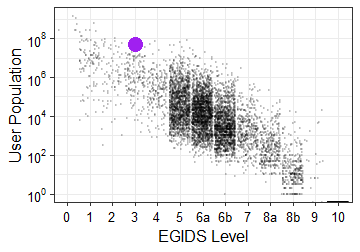
Full explanation
A language of China
- ISO 639
- nan
- Alternate Names
- Banlamgi, Banlamgu, Banlamue, Minnan, Southern Fujian, Southern Min
- Autonym
- 闽南语 (Minnanyu)
- Population
- 28,300,000 in China (2021). Total users in all countries: 50,275,890 (as L1: 49,888,890; as L2: 387,000).
- Location
- Fujian province: Xiamen; Hainan (Hainan dialect); Guangdong province: Chaozhou-Shantou far east corner (Chao-Shan dialect), Leizhou peninsula (Leizhou dialect), Shaxi and Zhongshan city south of Guangzhou (Longdu dialect island); Zhejiang province: Pingyang and Cangnan area, and Zhoushan archipelago (Zhedongnan dialect).
- Language Maps
- Southeastern China, Taiwan
- Language Status
- 5 (Developing). Language of recognized nationality: Han.
- Classification
- Sino-Tibetan, Chinese
- Dialects
- Leizhou (Lei, Lei Hua, Li, Li Hua), Chao-Shan (Chaozhou, Choushan, Shantou, Swatow, Teochew), Qiong-Wen (Hainan, Hainanese, Qiong-Lei, Qiongwen Hua), Datian, Quan-Zhang (Amoy, Changchew, Chinchew, Hokkien, Quanzhou, Taibei Hokkien, Xiamen, Zhangping-Longyan, Zhangzhou), Zhedongnan (Southeastern Zhejiang, Zhenan Min), Gandongbei (Northeastern Jiangxi). Amoy is the prestige dialect. Amoy and Taiwanese are easily mutually intelligible. Chao-Shan has difficult intelligibility with Amoy; Hainan quite different from other dialects and mutually unintelligible with Hokkien and Teochew. Most speakers in Thailand use Chaoshou dialect. Min Nan most widely distributed and influential Min variety. A member of macrolanguage Chinese [zho].
- Typology
- SVO; tone sandhi, tonal.
- Language Use
- Other speakers use it for commerce. Most domains. Used by all. Positive attitudes. Also use English [eng]. Also use Mandarin Chinese [cmn]. Also use Yue Chinese [yue]. Used as L2 by Lingao [onb], She [shx], Tsat [huq].
- Language Development
- Literacy rate in L2: 91% (2000 census, Han nationality). Highly literate in Chinese and they use that literature. Literature. Dictionary. Grammar. Bible: 1933.
- Writing
- Bopomofo script [Bopo], used since 1998, used in Taiwan. Han script, Simplified variant [Hans]. Katakana script [Kana], used between 1895–1945, once used in Taiwan. Latin script [Latn], used since 1850.
- Other Comments
- Traditional religion, Buddhist, Christian, Daoist.
- Language Resources
- OLAC resources in and about Chinese, Min Nan
Also Spoken in
- Language Status
- Unestablished
- Other Comments
- Non-indigenous. View other languages of Australia
Language Name
Chinese, Min Nan
User Population
17,900 in Australia (2016 census).
- Location
- Major cities.
- Dialects
- Hainan, Teochew (Chaochow, Tiuchiu), Hokkien (Fujian).
- Language Status
- 5 (Dispersed)
- Other Comments
- Non-indigenous. View other languages of Brunei
Language Name
Chinese, Min Nan
User Population
12,100 in Brunei (2019).
- Language Status
- Unestablished
- Other Comments
- Non-indigenous. View other languages of Canada
Language Name
Chinese, Min Nan
User Population
31,800 in Canada (2016 census).
- Location
- Scattered.
- Dialects
- Chiu Chao (Teochew).
- Language Status
- 5 (Dispersed)
- Other Comments
- Non-indigenous. View other languages of China–Hong Kong
Language Name
Chinese, Min Nan
User Population
493,000 in China–Hong Kong, all users. L1 users: 106,000 in China–Hong Kong (2016 census). 70,500 Fukien and 35,200 Chiu Chau (2016 census). L2 users: 387,000 (2016 census).
- Location
- Bali, Java, Kalimantan, and Sumatra provinces: scattered.
- Dialects
- Teochew (Chaochow, Tiu Chiu), Hokkien (Fujian).
- Language Status
- 8a (Moribund)
- Language Use
- Older adults only. Most remaining speakers are of the grandparent generation. Shifted to Indonesian [ind].
- Other Comments
- Non-indigenous. View other languages of Indonesia
Language Name
Chinese, Min Nan
User Population
766,000 in Indonesia (2015).
- Language Status
- Unestablished
- Other Comments
- Non-indigenous. View other languages of Japan
Language Name
Chinese, Min Nan
User Population
75,000 in Japan (Leclerc 2020b).
- Location
- Scattered.
- Dialects
- Hainan, Hokkien, Teochiu.
- Language Status
- 3 (Wider communication)
- Other Comments
- Non-indigenous. Confucianist, Daoist. View other languages of Cambodia
Language Name
Chinese, Min Nan
User Population
209,000 in Cambodia (2019 J. Leclerc).
- Location
- Johor, Kedah, Kelantan, and Terengganu.
- Dialects
- Hainanese, Teochew (Chaochow, Teochow), Hokkien (Amoy, Fujianese, Fukienese).
- Language Status
- 6a (Vigorous)
- Language Use
- All also use Hakka Chinese [hak]. Used as L2 by Hakka Chinese [hak].
- Other Comments
- Non-indigenous. View other languages of Malaysia
Language Name
Chinese, Min Nan
User Population
3,500,000 in Malaysia (2021 Joshua Project), based on ethnicity. Ethnic population: 6,410,000 (2014).
- Language Status
- Unestablished
- Other Comments
- Non-indigenous. View other languages of New Zealand
Language Name
Chinese, Min Nan
User Population
7,090 in New Zealand (2018 census).
- Location
- Major cities.
- Language Status
- 5 (Dispersed)
- Other Comments
- Non-indigenous. View other languages of Philippines
Language Name
Chinese, Min Nan
User Population
1,000,000 in Philippines (2010 J. Leclerc). 99% of Chinese population in the Philippines (1982).
- Location
- Mostly Telok Ayer area.
- Dialects
- Hokkien (Amoy, Fujian, Fukienese, Xiamen), Teochew (Chaochow, Chaozhou, Taechew), Hainanese.
- Language Status
- 3 (Wider communication)
- Language Use
- Hokkien is most widely understood variety in Singapore (1979 E. Kuo). Home, food centres, army, friends. Also use English [eng]. Also use Mandarin Chinese [cmn]. Used as L2 by Baba Malay [mbf].
- Other Comments
- Non-indigenous. View other languages of Singapore
Language Name
Chinese, Min Nan
User Population
625,000 in Singapore (2015 World Factbook). Includes 448,000 Hokkien and 177,000 Teochew. Ethnic population: 1,860,000 (2010 census). Includes 1,120,000 Hokkien, 562,000 Teochew, 178,000 Hainanese.
- Location
- Krung Thep province; used in capital cities of Chiang Mai, Nakhon Ratchasima, and Udon Thani provinces; used in other urban areas. Southern Min constitute the majority of Thai Chinese and speak the Teochew dialect.
- Dialects
- Hainan, Teochew (Chaochow, Chaozhou, Techu, Teochow, Tiuchiu), Hokkien (Fujian, Fukien).
- Language Status
- 5 (Dispersed)
- Other Comments
- Non-indigenous. Buddhist, traditional religion. View other languages of Thailand
Language Name
Chinese, Min Nan
User Population
1,520,000 in Thailand (Leclerc 2019a). 1,060,000 Chaochow, 17,600 Fujian, 5,880 Hainanese (1984).
- Location
- Widespread: east coast cities, western plain.
- Dialects
- Hokkien (Amoy, Chaenzo, Sanso).
- Language Status
- 3 (Wider communication)
- Language Use
- Most also use Mandarin Chinese [cmn]. Also use Japanese [jpn], especially adults over age 60. Used as L2 by Kanakanabu [xnb], Kavalan [ckv], Mandarin Chinese [cmn], Puyuma [pyu], Rukai [dru], Sediq [trv].
- Language Development
- Taught in some primary schools in early grades only.
- Other Comments
- Taiwanese people are called Hoklo or Holo. Traditional religion, Buddhist, Christian. View other languages of China–Taiwan
Language Name
Chinese, Min Nan
User Population
13,500,000 in China–Taiwan (2017 J. Leclerc).
- Language Status
- Unestablished
- Language Use
- Many also use English [eng].
- Other Comments
- Non-indigenous. View other languages of United States
Language Name
Chinese, Min Nan
User Population
219,000 in United States (2015 census). Identified in census as Formosan. United States Census figure for all Chinese varieties: 2,900,000 (2015).