
nun ISO 639
Anong Autonyms
Anong
Visualizations
Language Cloud
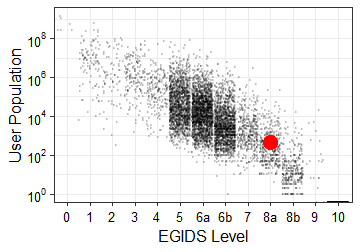
Full explanation
A language of Myanmar
- ISO 639
- nun
- Alternate Names
- Anoong, Anu, Anung, Fuch’ye, Fuchve, Khingpang, Kwingsang, Kwinp’ang, Naw, Nawpha, Nu
- Autonym
- Anong
- Population
- 400 in Myanmar (2000 D. Bradley), decreasing. Ethnic population: 10,000 (Bradley 2007b). Total users in all countries: 450.
- Location
- Kachin state: Kawnglangphu, Myitkyina, Putao, Machanbaw, and Tanai townships.
- Language Maps
- Northern Myanmar, South Central China
- Language Status
- 8a (Moribund).
- Classification
- Sino-Tibetan, Tibeto-Burman, Central Tibeto-Burman, Nungish
- Dialects
- Byabe, Kizolo, Nora. Slightly different dialects of Anong spoken in China and Myanmar, although no reported difficulty communicating with each other. Low inherent intelligibility with the Matwang variety of Rawang [raw]. Lexical similarity: 87%–89% with Anong in Myanmar and Anong in China, 73%–76% with T’rung [duu], 77%–83% with Matwang variety of Rawang [raw].
- Typology
- SOV.
- Language Use
- Older adults only. Neutral attitudes. Majority are indifferent that Anong is disappearing (Sun 2005). Shifted to Lisu [lis]. Some also use Rawang [raw].
- Language Development
- Some community literacy classes. Dictionary. Grammar. Bible: 2015.
- Writing
- Latin script [Latn].
- Other Comments
- Different from Nung (Tai family) of Vietnam, Laos, and China, and from Chinese Nung (Cantonese) of Vietnam. Anong is one of the 5 principal divisions of Rawang clans, along with Matwang [raw], Daru-Jerwang, Longmi, and Tangsar (Morse 1989:240). Christian.
- Language Resources
- OLAC resources in and about Anong
Also Spoken in
- Location
- Yunnan province: Nujian Lisu autonomous prefecture, central Fugong county, Shangpa town, Mugujia village cluster; Thanlwin (Salween) (Nu) river area.
- Dialects
- Cholo, Gwaza, Miko.
- Language Status
- 8a (Moribund)
- Language Use
- Older adults only. Neutral attitudes. A few leaders are concerned about its loss. Most shifted to Lisu [lis] (Bradley 2007a). Some shifted to Mandarin Chinese [cmn]. Used as L2 by Central Bai [bca].
- Language Development
- Literacy rate in L2: 68% literate in any language (2000 census, Nu nationality).
- Other Comments
- Non-indigenous. Different from Nung [nut] (Tai family) of Vietnam, Laos, and China, Nong Zhuang (Tai family) of China, and from Chinese Nung (Yue [yue]) of Vietnam. Due to intense linguistic contact with the Lisu, Anong is being radically restructured (Sun and Liu 2009). Traditional religion, Buddhist, Christian. View other languages of China
Language Name
Anong
User Population
50 in China (Bradley 2007a). One-third of ethnic group are speakers and another one-third have passive knowledge (Bradley 2007a). No monolinguals. Ethnic population: 7,300 (Bradley 2007a).