
pov ISO 639
Kiriol Autonyms
Guinea-Bissau Creole
Visualizations
Language Cloud
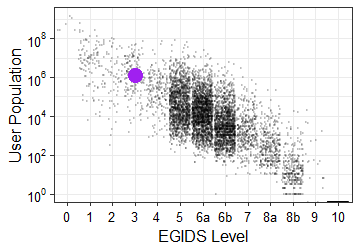
Full explanation
A language of Guinea-Bissau
- ISO 639
- pov
- Alternate Names
- Crioulo, Crioulo de Guinea-Bissau, Guinea-Bissau Kriyol, Guineense, Kriol, Kriulo, Portuguese Creole, Upper Guinea Crioulo
- Autonym
- Kiriol
- Population
- 1,800,000 in Guinea-Bissau, all users. L1 users: 272,000 in Guinea-Bissau (2022 SIL), increasing. Transition from L2 to L1 use is limited to the capital city of Bissau (2019 S. Graham). L2 users: 1,528,000 (2022 SIL). Total users in all countries: 1,888,500 (as L1: 340,500; as L2: 1,548,000).
- Location
- Widespread, with predominance in the capital.
- Language Maps
- Guinea and Guinea-Bissau, Guinea-Bissau
- Language Status
- 3 (Wider communication). De facto language of national identity. Primary LWC in Guinea-Bissau. Developed as a trade language with the Portuguese during the colonial period. Has its origins in the Upper Guinea Creole that developed on Santiago island in Cabo Verde, spreading to the mainland and then to the Casamance region of Senegal and to all of Guinea-Bissau. Guinea-Bissau Creole is now an L2 that is actively supported by all ethnic groups in the country and used in most domains of public life outside of education. Has become a marker of national identity and solidarity.
- Classification
- Creole, Portuguese based
- Dialects
- Bissau-Bolama Creole, Geba Creole, Cacheu Creole. Some lexical similarity with Casamance Creole [pov] in Senegal, and with the Kabuverdianu [kea] variety spoken on the island of Santiago.
- Language Use
- Growing as an L1 in the capital city of Bissau. Home, friends, work, commerce, entertainment. Has even taken over previous domains of Portuguese [por] such as use in most churches and many functions of government. Positive attitudes. Many also use Portuguese [por], the language of education, governmental operations, industry, and business with international relations. Used as L2 by Bainouk-Gunyuño [bab], Balanta [ble], Biafada [bif], Bijagó [bjg], Fula [fuc], Futa Fula [fuf], Jola Bayote [bda], Jola-Felupe [eja], Kabuverdianu [kea], Kanjad [pbp], Kasanga [ccj], Kobiana [kcj], Mandinka [mnk], Mandjak [mfv], Mankanya [knf], Mansoanka [msw], Nalu [naj], Papel [pbo], Soninke [snk], Susu [sus].
- Language Development
- Literacy rate in L2: 48% in Portuguese [por]. Literature. Newspapers. Radio. Videos. Dictionary. Grammar. Bible: 1999.
- Writing
- Latin script [Latn].
- Other Comments
- Muslim, Christian, traditional religion.
- Language Resources
- OLAC resources in and about Guinea-Bissau Creole
Also Spoken in
- Location
- Ziguinchor region: Ziguinchor city and surrounding villages.
- Dialects
- None known. Casamance Creole is different from Guinea-Bissau Creole, due to its distinct development path in French West Africa since 1886. However, there is some intelligibility between the two.
- Language Status
- 6b (Threatened)
- Language Use
- The existence of a context in the Casamance, that is supportive of L2 to L1 transition, is highly unlikely. Most also use French [fra]. Casamance Creole speakers tend to be the more educated segment of the population. Most also use Wolof [wol]. Wolof [wol] now has more L2 speakers than any other language in the Casamance region. Used as L2 by Bandial [bqj], Bayot [bda], Jola-Fonyi [dyo], Jola-Kasa [csk], Mandinka [mnk], Mankanya [knf].
- Language Development
- There has been some resistance to wolofization from the Casamance secessionists’ movement, who want to revive Casamance Creole [pov] as the LWC for the Casamance (Sarr and Thiaw 2012).
- Other Comments
- Non-indigenous. Genesis of continental Portuguese-based Creole occurred in a fort founded on the mouth of the Cacheu River in 1645, and from there spread throughout Portuguese Guinea. The Casamance region of Portuguese Guinea was traded from Portugal to France in 1886, creating an independent development path for the Portuguese-based Creole spoken in that new region in French West Africa. Christian. View other languages of Senegal
Language Name
Casamance Creole
User Population
30,000 in Senegal, all users. L1 users: 10,000 in Senegal (Biagui and Quint 2013), decreasing. A significant population (2,500) speaks Casamancese Creole in Dakar (Biagui and Quint 2013). L2 users: 20,000 (Biagui and Quint 2013).
- Language Status
- Unestablished
- Language Use
- Most also use Gambian Wolof [wof], as the language of commerce and media (Biel 2014). Many also use English [eng], as the language of education and government (Biel 2014). Also use Mandinka [mnk], as the secondary LWC for commerce and media (Biel 2014).
- Other Comments
- Non-indigenous. View other languages of Gambia
Language Name
Guinea-Bissau Creole
User Population
21,300 in Gambia (2016).
- Language Status
- Unestablished
- Other Comments
- Non-indigenous. View other languages of Netherlands
Language Name
Guinea-Bissau Creole
User Population
13,500 in Netherlands (2019).
- Language Status
- 5 (Dispersed)
- Language Use
- Most also use Portuguese [por], as the language of education, government, business, and upward mobility.
- Other Comments
- Non-indigenous. View other languages of Portugal
Language Name
Guinea-Bissau Creole
User Population
23,700 in Portugal (2007 J. Leclerc).