
psd ISO 639
Plains Indian Sign Language
Visualizations
Language Cloud
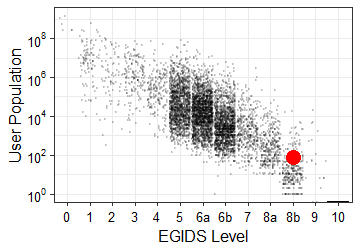
Full explanation
A language of United States
- ISO 639
- psd
- Alternate Names
- AISL, American Indian Sign Language, Hand Talk, Indian Language of Signs, Indian Sign Language, NAISL, North American Indian Sign Language, PISL, PST, Plains Sign Language, Plains Sign Talk, Sign Talk
- Population
- 75 in United States (2015 M. McKay-Cody), all users. Total users in all countries: 75.
- Location
- Scattered. Great Plains and neighboring regions, particularly on reservations of Apache, Assiniboine, Blackfeet, Cheyenne, Chippewa, Crow, Hidatsa/Mandan, Kalispel, Kiowa, Kutenai, Lakota, Mandan, Navajo, Pawnee and Southern Tiwa tribes.
- Language Maps
- Language Status
- 8b (Nearly extinct). Formerly used as a lingua franca for inter-tribal contact among at least 40 different language groups by hearing and deaf people. In 1890, a private census reported 100,000 users (McKay-Cody 1996). Wide range of genres including story-telling, prayers, inter-tribal negotiation, and bartering (Davis 2010).
- Classification
- Sign language, Shared sign language
- Dialects
- Plains Standard Indian Sign Language, Navajo Sign Language. Some variation in PISL by ethnic group and region, but dialect differences generally do not impede communication among different tribes. Many signs are associated with specific tribes (2016 M. McKay-Cody), but the degree to which the different tribal varieties represent separate languages has not been systematically assessed (McKay-Cody 2019). Lexical similarity between available historical sources on PISL ranges from 80% to 92%. Comparison of these sources with American Sign Language [ase] shows 50% similarity (Davis 2010).
- Typology
- SOV; compounding (head-initial); verb agreement; classifier predicates.
- Language Use
- Used by deaf people with family and friends as a primary sign language, more elaborate than its use as a lingua franca (an ‘alternative sign language’) (McKay-Cody 1996). Elderly only. Those who use it are widely scattered. Shifted to American Sign Language [ase].
- Language Development
- Videos.
- Other Comments
- Sign language use by Native Americans is documented in many parts of North America, from the Arctic to Mexico, including the Northeastern, Southeastern, and Southwestern United States, and apparently predates European contact. In North America, these can be organized into six extant groups: Northeast (Oneida, Iroquois), Plains (esp. Cheyenne, Crow, Kiowa), Great Basin (Ute), Southwest (Navajo, Hopi, Pueblo, Apache), Northwest (Inuit), West Coastal (Chumash) (McKay-Cody 2019). Some of these varieties are recognized in ISO 639-3 as separate languages, others are clearly distinct languages but not yet with their own ISO codes (e.g. Keresan Pueblo Sign Language), while for others their relationship to PISL is not yet determined (and may never be, since some are extinct). Some specific tribal varieties bear the tribal name; many of these appear to be dialects of PISL. The names ‘(North) American Indian Sign Language’ are often used when a broader range of varieties is considered (McKay-Cody 1996, Davis 2010).
Also Spoken in
- Location
- Scattered. Great Plains and neighboring regions, particularly on reserves of Assiniboine, Blackfeet, and Kutenai First Nations.
- Dialects
- Far Northern Plains Indian Sign Language.
- Language Status
- 8b (Nearly extinct)
- Language Use
- Elderly only. A few very elderly hearing people and some middle-aged or older deaf people. Shifted to American Sign Language [ase]. View other languages of Canada
Language Name
Plains Indian Sign Language
User Population
Small rapidly diminishing population.