
rsl ISO 639
Russian Sign Language
Visualizations
Language Cloud
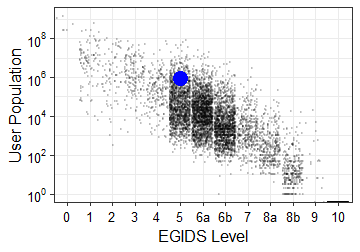
Full explanation
A language of Russian Federation
- ISO 639
- rsl
- Population
- 700,000 in Russian Federation (2021 DBS/DOOR/SIL). Estimated 430,000–860,000 deaf signers, assuming 0.3%–0.6% of total population. Other estimates: 121,000 (2010 census); 715,000 (2014 IMB). Total users in all countries: 909,000.
- Location
- Scattered. Moscow and Saint Petersburg are major centers.
- Language Maps
- Sign Languages of Asia, Sign Languages of Europe
- Language Status
- 5 (Developing).
- Classification
- Sign language, Deaf community sign language
- Dialects
- Some dialect variation across Russia but communication is easy between all parts of the country (2020 N. Andrianova). Relatively high lexical similarity to sign languages in Ukraine [ukl] and Moldova [vsi]. Reported historical connections to sign languages in Austria and France, but not much evidence of this from extensive wordlist comparison (Bickford 2005).
- Typology
- One-handed fingerspelling (Cyrillic script).
- Language Use
- Vigorous. Hundreds of residential schools for deaf; some vocational schools, mainly oralist. Deaf associations and athletic clubs. Some interpreters. Some sign language classes for hearing people, mostly in large cities. Organization for sign language teachers. Used by all. Some also use Russian [rus], primarily written.
- Language Development
- TV. Videos. Dictionary. Agency: Vserosiyskoe obshestvo gluhih (VOGh, All-Russian Society of the Deaf).
- Other Comments
- Exists alongside Signed Russian, which uses RSL signs with Russian grammar. Some people distinguished the two systems carefully, while others use ‘Russian Sign Language’ for both (2020 N. Andrianova). First school for the deaf opened at Pavlovsk near St. Petersburg in 1806. Reported to also be used in Federal Republics such as Chechnya, and in countries formerly part of the Soviet Union, such as Moldova, Ukraine, Belarus, Kazakhstan, Kyrgyzstan, Tajikistan, and Uzbekistan. Some of these appear to be dialects of RSL; others have diverged significantly and are now distinct languages. Christian.
Also Spoken in
- Location
- Scattered.
- Language Status
- 5 (Developing)
- Language Use
- Some also use Armenian Sign Language [aen]. Used as L2 by Armenian Sign Language [aen].
- Language Development
- Taught in at least one deaf school (2020 N. Andrianova).
- Other Comments
- Non-indigenous. Both Armenian SL [aen] and Russian SL are present in Armenia, and usually not clearly distinguished, but there are substantial differences between them; see entry on Armenian SL (2020 N. Andrianova). View other languages of Armenia
Language Name
Russian Sign Language
- Location
- Scattered.
- Dialects
- High lexical similarity and intelligibility with Russian SL in Russia, with some dialect differences.
- Language Status
- 6a (Vigorous)
- Language Use
- Used by all.
- Other Comments
- Non-indigenous. View other languages of Belarus
Language Name
Russian Sign Language
User Population
28,000 in Belarus (2021 DBS/DOOR/SIL). Estimated 19,000–38,000 deaf signers, assuming 0.2%–0.4% of total population.
- Location
- Harju county: Tallinn.
- Language Status
- 6a (Vigorous)
- Language Use
- Used in Tallinn by deaf Russians. In other regions Russians use some pidginized versions of Russian Sign Language mixed with Estonian Sign Language. Used as L2 by Estonian Sign Language [eso].
- Language Development
- Agency: Estonian Association of the Deaf.
- Other Comments
- Non-indigenous. View other languages of Estonia
Language Name
Russian Sign Language
- Location
- Scattered.
- Language Status
- Unestablished
- Language Use
- Home; Mixed use: Community. Adults only. Shifting to Israeli Sign Language [isr] (Yoel 2007). Also use Hebrew [heb] (Yoel 2007).
- Other Comments
- Non-indigenous. Used by deaf immigrants from the former Soviet Union, but they are scattered throughout the country and most have little opportunity to interact with other Russian deaf or use the language outside the home, leading to attrition of RSL skills. Adult immigrants learn ISL [isr] and Hebrew [heb] in immigrant language classes. Deaf children are not learning RSL, rather they learn ISL and Hebrew in regular deaf education (Yoel 2007). Jewish. View other languages of Israel
Language Name
Russian Sign Language
User Population
1,000 in Israel (Yoel 2007). Estimated number of deaf immigrants from the former Soviet Union since 1988.
- Location
- Scattered.
- Dialects
- Very high lexical similarity with Russian SL in Russia, especially in Bishkek, with somewhat greater variation in the south (2020 N. Andrianova).
- Language Status
- 5 (Developing)
- Other Comments
- Non-indigenous. View other languages of Kyrgyzstan
Language Name
Russian Sign Language
User Population
32,000 in Kyrgyzstan (2021 DBS/DOOR/SIL). Estimated 19,000–39,000 deaf signers, assuming 0.3%–0.6% of total population.
- Location
- Scattered.
- Dialects
- None known. Very high comprehension of RSL videos from Russia (2020 N. Andrianova). Slight lexical differences between north and south (2020 N. Andrianova).
- Language Status
- 5 (Developing)
- Language Use
- Vigorous. All domains. Used by all. Some also use Russian [rus].
- Language Development
- Deaf schools teach Russian Sign Language and Russian (2020 N. Andrianova).
- Other Comments
- Non-indigenous. View other languages of Kazakhstan
Language Name
Russian Sign Language
User Population
56,000 in Kazakhstan (2021 DBS/DOOR/SIL). Estimated 37,000–74,000 deaf signers, assuming 0.2%–0.4% of the general population.
- Location
- Scattered.
- Language Status
- 6a (Vigorous)
- Language Use
- Used by all. Some also use Russian [rus], primarily written.
- Other Comments
- Non-indigenous. Moldova Sign Language [vsi] and Russian Sign Language are not clearly distinguished in Moldova; see further comments in entry for Moldova SL. View other languages of Moldova
Language Name
Russian Sign Language
User Population
5,000 in Moldova (2021 DBS/DOOR/SIL). Estimated 5,000–13,000 deaf signers in Moldova for all sign languages, assuming 0.2%–0.5% of total population. Other estimates: 5,000 (2017 N. Andrianova), 17,500 (2014 IMB).
- Location
- Scattered, with concentrations around Dushanbe.
- Dialects
- Includes some local signs, and some grammatical differences from standard RSL that suggest it may need to be considered a separate language. Considerable variation within Tajikistan, since many deaf have never attended school and have had little exposure to the standard variety (2019 J. Power).
- Language Status
- 5 (Developing)
- Language Use
- Vigorous. Used by all. Some also use Russian [rus]. Deaf people born before about 2000 learned Russian in school. Some also use Tajik [tgk]. Deaf people born after about 2000 have been taught Tajik in schools, and the government currently promotes Tajik over Russian.
- Other Comments
- Non-indigenous. Two schools for the deaf in Dushanbe area (grades 1–10), another in Khujand, with a mixture of oralist approaches and some use of signs (2019 J. Power). Muslim. View other languages of Tajikistan
Language Name
Russian Sign Language
User Population
47,000 in Tajikistan (2021 DBS/DOOR/SIL). Estimated 28,000–56,000 signing deaf, assuming 0.3%–0.6% of total population.
- Location
- Scattered.
- Dialects
- None known. Very high intelligibility with Russian SL in Russia (2020 N. Andrianova).
- Language Status
- 6a (Vigorous)
- Language Use
- Used by all.
- Other Comments
- Non-indigenous. View other languages of Turkmenistan
Language Name
Russian Sign Language
User Population
18,000 in Turkmenistan (2021 DBS/DOOR/SIL). Estimated 12,000–24,000 deaf signers, assuming 0.2%–0.4% of total population.
- Location
- Scattered.
- Dialects
- None known. Very high intelligibility with Russian SL in Russia (2020 N. Andrianova).
- Language Status
- 6a (Vigorous)
- Language Use
- Used by all.
- Other Comments
- Non-indigenous. View other languages of Uzbekistan
Language Name
Russian Sign Language
User Population
22,000 in Uzbekistan (2008 WFD). Another estimate: 100,000–200,000, assuming 0.3%–0.6% of the total population (2021 DBS/DOOR/SIL).