
sfs ISO 639
South African Sign Language
Visualizations
Language Cloud
Full explanation
A language of South Africa
- ISO 639
- sfs
- Alternate Names
- SASL
- Population
- 500,000 (Aarons and Akach 2002), all users. Estimated, including some hearing people. L1 users: 235,000 (2011 census). Approximately 0.4% of the total population. Other estimates vary widely: 12,100 (Van Cleve 1986); 400,000–500,000 (2008 WFD).
- Location
- Scattered.
- Language Maps
- Sign Languages of Africa
- Language Status
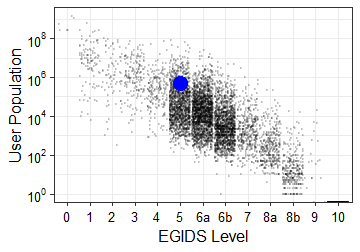
- 5 (Developing). Recognized language (1996, Constitution, Chapter 1, Section 6(5)(a)), although not an official language, it is recognized as a language to be promoted.
- Classification
- Sign language, Deaf community sign language
- Dialects
- Substantial dialect variation, traditionally associated with different regions, schools and racial groups, but with widespread mutual intelligibility based on familiarity with the different (mostly lexical) variations (Aarons and Akach 2002). One particular variety (out of almost 12) is used in instructional materials at the University of the Free State (Akach and Naude 2008), which is also leading toward standardization. 60% related to British Sign Language [bfi] and Auslan [asf], few to American Sign Language [ase].
- Language Use
- Vigorous. Understood to some degree by most deaf people. Some interpreters provided in courts. Used by all.
- Language Development
- TV. Dictionary. Agency: Deaf Federation of South Africa (DEAFSA).
- Other Comments
- First deaf school established 1863 by Irish Dominicans, resulting in early influence from Irish SL [isg]. Other schools established over the next century, with a strong emphasis on oralism in schools for children of European descent, while schools for black deaf permitted some use of signs. Different signing systems developed in different schools, but over time they have converged in ways that are mutually intelligible throughout the country, although with considerable lexical variation (Aarons and Akach 2002).