
wol ISO 639
Wolof, ولوفل (Wolof) Autonyms
Wolof
Visualizations
Language Cloud
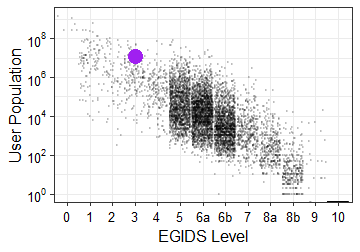
Full explanation
A language of Senegal
- ISO 639
- wol
- Alternate Names
- Ouolof, Volof, Walaf, Waro-Waro, Yallof
- Autonym
- Wolof, ولوفل (Wolof)
- Population
- 12,208,000 in Senegal, all users. L1 users: 5,868,000 in Senegal (2013 census). L2 users: 6,340,000 (2017). Ethnic population: 6,900,000 (2017). Total users in all countries: 12,276,290 (as L1: 5,936,290; as L2: 6,340,000).
- Location
- Widespread.
- Language Maps
- Mauritania, Senegal and The Gambia
- Language Status
- 3 (Wider communication). Recognized language (2001, Constitution, Article 1). Wolof has become an LWC through commerce and trade and is the lingua franca in much of the country. The phenomenon of ‘wolofization’ has meant that people from many ethnic groups have adopted Wolof as their L1; most of the Senegalese population can speak and understand Wolof (2015 J. Leclerc).
- Classification
- Niger-Congo, Atlantic-Congo, Atlantic, Northern, Senegambian, Fula-Wolof, Wolof
- Dialects
- Baol, Cayor, Dyolof (Djolof, Jolof), Lebou (Lebu), Jander, Urban Wolof (Dakar-Wolof). Urban Wolof speakers have some difficulty understanding the Wolof spoken in rural areas, but the reverse does not pose the same difficulty. Wolof [wol] is different from Gambian Wolof [wof].
- Typology
- SVO; prepositions; no noun classes, but class particles; definite article; passives; tense and aspect; 25 consonant and 16 vowel phonemes; non-tonal.
- Language Use
- Youth are shifting to Urban Wolof. All domains. Many also use French [fra], as the language of education and government (Diouf et al 2017). Used as L2 by Badyara [pbp], Bainouk-Gunyaamolo [bcz], Bainouk-Samik [bcb], Balanta-Ganja [bjt], Bambara [bam], Bandial [bqj], Bayot [bda], Casamance Creole [pov], Ejamat [eja], Gusilay [gsl], Hassaniyya [mey], Jalunga [yal], Jola-Fonyi [dyo], Jola-Kasa [csk], Kabuverdianu [kea], Karon [krx], Kerak [hhr], Krio [kri], Kuwaataay [cwt], Laalaa [cae], Mandinka [mnk], Mandjak [mfv], Mankanya [knf], Ménik [tnr], Mlomp [mlo], Ndut [ndv], Noon [snf], Oniyan [bsc], Paloor [fap], Pulaar [fuc], Pular [fuf], Saafi-Saafi [sav], Serer-Sine [srr], Soninke [snk], Wamey [cou], Western Maninkakan [mlq], Xasonga [kao], Zenaga [zen].
- Language Development
- Literacy rate in L1: 2%. Taught in primary schools as subject. Radio. Dictionary. Grammar. NT: 1988–2010.
- Writing
- Arabic script, Naskh variant [Arab]. Latin script [Latn], primary usage.
- Other Comments
- Muslim.
- Language Resources
- OLAC resources in and about Wolof
Also Spoken in
- Language Status
- Unestablished
- Other Comments
- Non-indigenous. View other languages of Canada
Language Name
Wolof
User Population
3,990 in Canada (2016 census).
- Language Status
- Unestablished
- Other Comments
- Non-indigenous. View other languages of France
Language Name
Wolof
User Population
35,000 in France (2015 J. Leclerc).
- Location
- Bissau region.
- Language Status
- Unestablished
- Language Use
- All also use French [fra]. Used as L2 by Djakanka [jad].
- Other Comments
- Non-indigenous. Muslim. View other languages of Guinea-Bissau
Language Name
Wolof
User Population
10,000 in Guinea-Bissau (2022 SIL). Ethnic population: 10,000 (2022 Joshua Project).
- Location
- Brakna and Trarza regions.
- Dialects
- Baol, Cayor, Dyolof (Djolof, Jolof), Lebou, Ndyanger.
- Language Status
- 5 (Dispersed)
- Language Use
- Trade. Used by all. Positive attitudes. All also use French [fra], as the language of education, media and government. Most also use Hassaniyya [mey], as the language of commerce and interethnic communication. Many also use Standard Arabic [arb], as the language of government, media, and religion (Ould Ahmed 2012).
- Language Development
- Literacy rate in L2: 50% in French [fra].
- Other Comments
- Muslim. View other languages of Mauritania
Language Name
Wolof
User Population
19,300 in Mauritania (2017), increasing.