
xki ISO 639
Kenyan Sign Language
Visualizations
Language Cloud
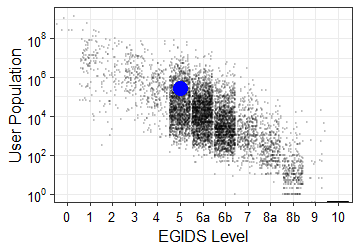
Full explanation
A language of Kenya
- ISO 639
- xki
- Alternate Names
- KSL
- Population
- 260,000 (2021 DBS/DOOR/SIL), increasing. Estimated 160,000–320,000 deaf signers, assuming 0.3%–0.6% of total population. Other estimates: 340,000 (2007 DOOR); 600,000 (Wilson and Kakiri 2011).
- Location
- Scattered.
- Language Maps
- Sign Languages of Africa
- Language Status
- 5 (Developing). Recognized language (2010, Constitution, Article 7(3b) National, official and other languages; and Article 120(1) Official Languages of Parliament).
- Classification
- Sign language, Deaf community sign language
- Dialects
- Nairobi (central), Kisumu (western), Mombasa (eastern). Standardized with minor variations between dialects since 1961, when primary schools for deaf children began. Mainly unrelated to other sign languages, although appears to have influenced Uganda Sign Language [ugn]. There appears to be less lexical borrowing (fingerspelling, initialization) from spoken languages than in many other sign languages. Fingerspelling system similar to French Sign Language [fsl].
- Typology
- One-handed fingerspelling.
- Language Use
- Church, government, courts. Mainly those in schools and over 15 years old. Neutral attitudes. Also use English [eng]. Also use Swahili [swh].
- Language Development
- Schools under the Kenya Institute of Education use Kenyan version of (American) Signed Exact English, including 1 at Machakos. KSL used at Nyangoma School at Bondo, a primary and boys’ technical school (Sakwa), and in 1 girl’s school. Taught in primary and secondary schools. TV. Dictionary. Bible portions: 2010–2013. Agencies: Kenya National Association of the Deaf (KNAD); Kenyan Sign Language Research Project (KSLRP) at the University of Nairobi; Kenyan Sign Language Interpreters Association (KSLIA); Kenyan Interpreters and Translators Association (KITA).